

7 Things Every Desi Kid Wishes Their Parents Understood About Growing Up in Canada
Growing Up Second-Generation South Asian in Canada
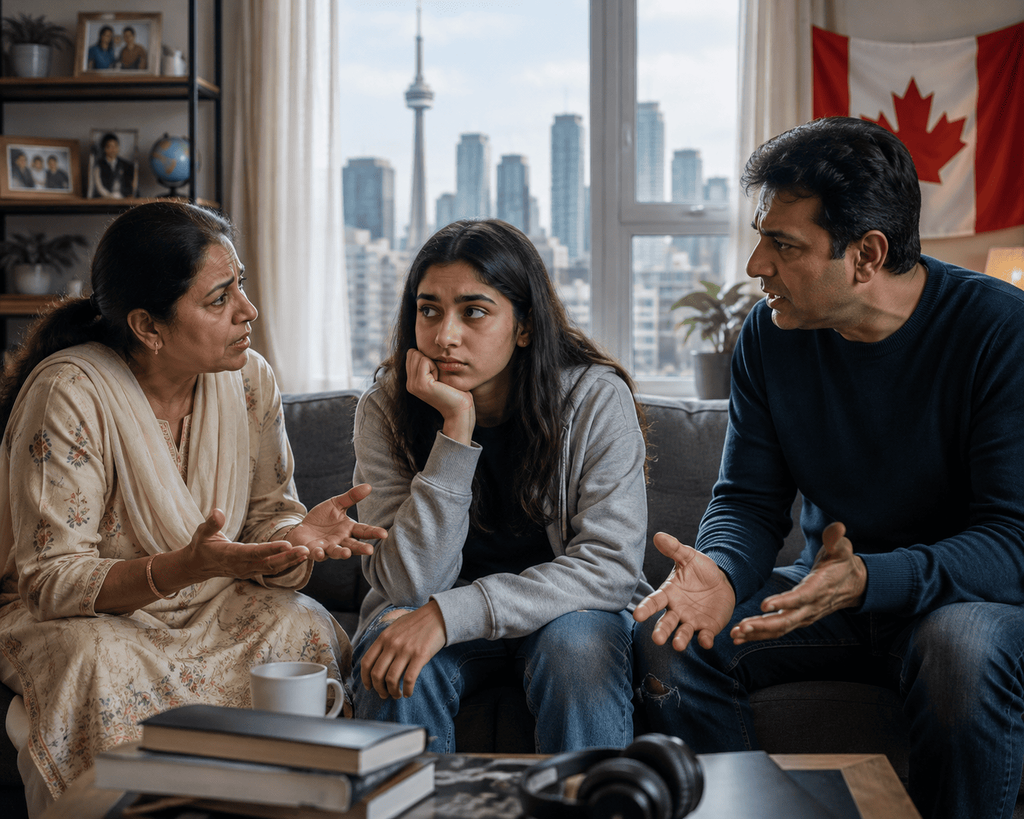
The fight started over a birthday party.
Or at least that’s what I believed when I was nine.
A classmate,Ryan had invited everyone over on the same Saturday as our community Diwali celebration. I wanted to go to the birthday party. My parents wanted me at the Diwali function. I remember thinking it was a simple choice between two events.
When my mom heard that I wanted to go to the birthday party instead, she looked at me and said something that’s stayed with me for more than twenty years.
“We didn’t come all this way for you to forget where you come from.”
At nine, I totally overreacted.
But now at twenty-nine, I realize we were arguing about two different ideas of what it meant to belong.
01 · SUCCESS
Every Report Card Meant Something Different
My parents celebrated every good grade like we’d all won something together.
Back then, I thought they were obsessed with marks.
Now I understand they were obsessed with security.
A University of British Columbia study on second-generation South Asian youth found a real gap in how immigrant parents and their kids defined success. For many first-generation parents, education wasn’t just about getting a good job,it justified leaving behind careers, family, language, and certainty. Success meant the sacrifices had been worth it.
For many of us growing up in Canada, success looked different: meaningful work, room to be creative, the chance to figure out what actually interested us.
Neither generation was chasing the wrong dream. We were solving different problems.
When my parents worried about stability, they were remembering everything they’d risked. When I wanted freedom, I was responding to a country that told me I could become almost anything. Both made sense. Neither sounded reasonable to the other.
02 · BELONGING
Too Indian Here. Too Canadian There.
Nobody prepares you for how lonely it can feel to belong almost everywhere but never completely anywhere.
At family gatherings, there was always someone reminding me not to become “too Canadian.” At school, there was always someone asking where I was really from. Somehow both places made me feel like I wasn’t quite enough.
CBC’s reporting on children of immigrants in Canada found this exact experience showing up across communities: feeling not Indian enough and not Canadian enough, at the same time, from both directions.
That’s a different experience than simply growing up with two cultures. It means constantly adjusting depending on who’s in the room,speaking one way with your grandparents, another with your teachers, laughing at different jokes, explaining different parts of yourself. You become fluent in code-switching long before you know there’s a word for it.
03 · EVERY QUESTION
Every Question Was Never Really About the Question
When I asked why I couldn’t sleep over at a friend’s house, the conversation somehow became about respect. When I questioned a family rule, it became about gratitude. When I wanted to spend more time with friends, it became about forgetting my culture.
Looking back, I don’t think my parents believed every question was rebellion. I think they were afraid that every small compromise would eventually become a bigger one.
Because immigrant families know something children don’t: cultures disappear one skipped celebration, one forgotten language, one family tradition at a time.
I wasn’t trying to erase anything. I was trying to figure out what growing up looked like in a country that asked different questions than the one my parents had left.

04 · INTERDEPENDENCE
The Family Didn’t Get Smaller. The Circle Just Got Bigger.
When I moved into my own apartment, everyone assumed I’d finally become “independent.” Except my family didn’t become less involved in my life. My mom still called to check if I’d eaten. My dad still wanted updates before major decisions. When my grandmother wasn’t feeling well, nobody wondered whose responsibility it was,we all showed up.
That’s something Western ideas about adulthood struggle to explain. South Asian families often work through interdependence rather than complete independence,financially, emotionally, socially. That’s not dysfunction. It’s a different family structure.
Staying deeply connected to your parents as an adult doesn’t mean you failed to grow up. Sometimes it means you grew up exactly the way your family hoped you would.
05 · RAISING THE NEXT GENERATION
Raising Our Kids Differently Doesn’t Mean Loving You Less
I’ve watched friends become parents over the last few years. They still want their children to respect their grandparents, celebrate Diwali, know their languages, visit family. But they’re also giving their kids room to ask questions we were often afraid to ask.
Many second-generation Canadians are raising their own kids with more flexible gender roles and looser parenting styles than they grew up with. To grandparents, that can look like tradition disappearing. To second-generation parents, it feels like tradition adapting.
The values haven’t changed. Only the methods have.
The greatest gift immigrant parents gave many of us wasn’t a rulebook. It was the chance to decide which traditions deserved to grow alongside us.
Maybe We Were Never On Opposite Sides
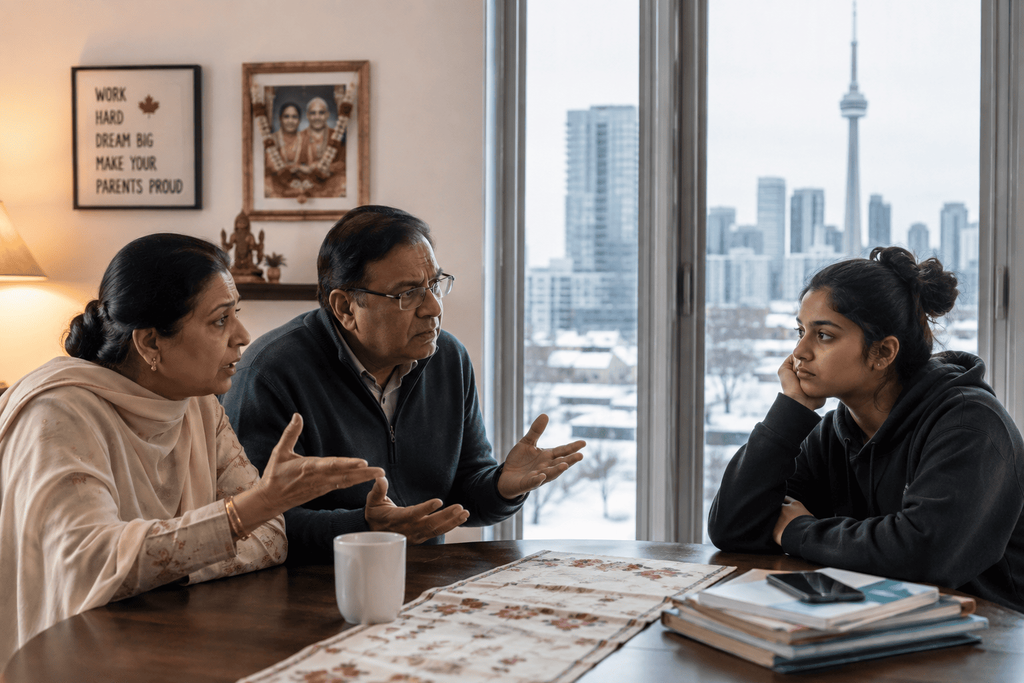
I still think about that birthday party. Not because I remember the games,honestly, I barely do. I remember my mother’s face. I remember feeling misunderstood.
I imagine she remembers feeling scared. Scared that the country she’d worked so hard to build a life in would slowly pull her children away from everything she’d hoped to preserve.
I wish I could tell nine-year-old me that. And I wish I could tell my mom something too: I was never trying to become less Desi. I was trying to become the kind of Canadian she had sacrificed so much for me to become.
Those goals were never opposites. They just looked that way from two sides of one generation.
When we challenged a rule, we weren’t rejecting our family. When we asked difficult questions, we weren’t rejecting our culture. When we tried to build an identity that looked a little different from yours, we weren’t leaving you behind.
We were carrying everything you gave us into a country that asked us to write the next chapter ourselves.
The tension wasn’t something we imagined, and it wasn’t proof our families were broken. It was two generations loving each other while growing up in two different versions of the same world.
Maybe understanding that isn’t the end of the conversation. Maybe it’s where it can finally begin.








 Previous Post

